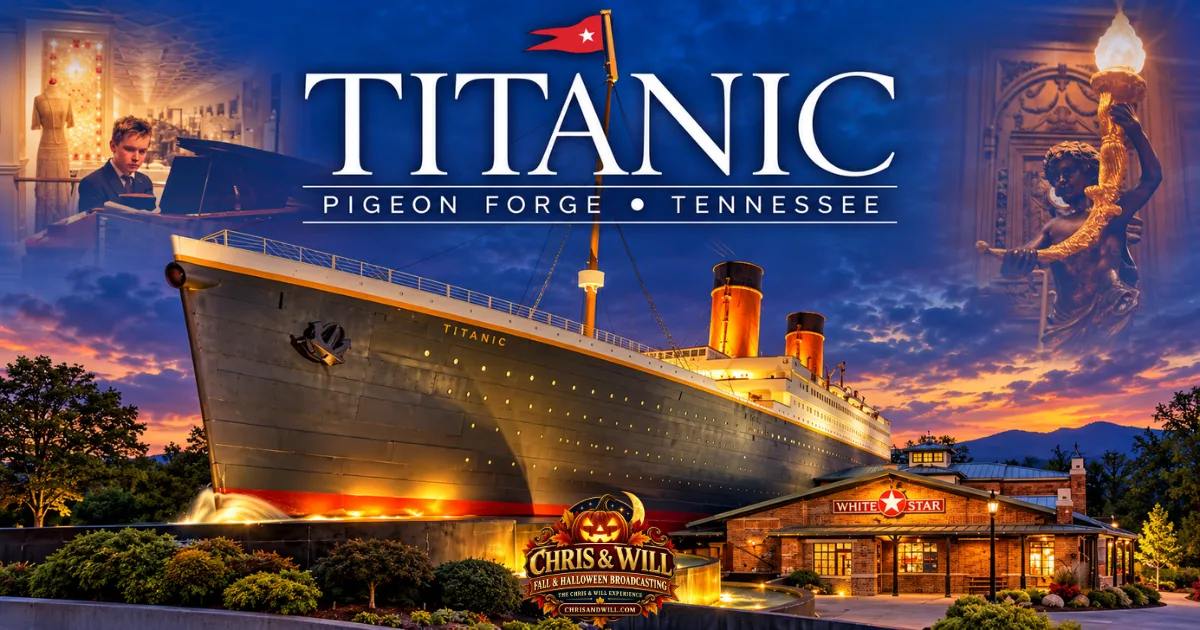
Personal stories, recreated spaces, and chilling hands-on experiences transform one of history’s most famous maritime disasters into something far more human.
Experience courtesy of My Pigeon Forge
Written by Christopher L. Antie
Few names in history carry the immediate recognition of Titanic. More than a century after the ship disappeared beneath the North Atlantic, its story remains surrounded by fascination, tragedy, questions, and an enduring curiosity about the people who boarded believing they were beginning a journey—not entering history.
During our recent travels through East Tennessee, Will and I returned to the Titanic Museum Attraction in Pigeon Forge. From the Parkway, the massive ship-shaped exterior is impossible to miss. Admittedly, our first impression was that the building leans heavily into the theatrical side of Pigeon Forge tourism. Once we stepped through the doors, however, that impression changed considerably.
The Titanic Museum Attraction is designed to honor the passengers and crew of RMS Titanic while allowing visitors to experience elements of life aboard the ship. According to the museum, its attractions contain more than 400 artifacts connected to Titanic and its passengers. Visitors can walk recreated hallways, cabins, parlors, and the Grand Staircase while following the story of an actual person who sailed aboard the ship.
That personal connection begins at boarding.
Guests receive a boarding pass representing an actual Titanic passenger or crew member before eventually learning that person’s fate in the Memorial Room, where the museum displays the names of all 2,208 people aboard.
For our visit, the stories included Sidney Collett and Major Archibald Butt. Our guide carried those stories throughout the experience, eventually revealing that Butt died in the disaster while Collett survived. Having names attached to the history immediately made the visit feel less like a collection of dates and objects and more like a story about individuals.
Our guide became one of the strongest elements of the entire visit.
Dressed as a period maid, she never allowed the character presentation to overpower the seriousness of the story. She was knowledgeable, approachable, respectful, and extraordinarily effective at moving us through the museum while adding historical context beyond what we could read on a display.
Without that interpretation, the museum would still offer an enjoyable walk through Titanic history. With it, the attraction became something considerably more immersive.
The journey unfolds naturally from life aboard the ship toward the sinking and its aftermath. Recreated spaces explore differences among the passenger classes, daily routines, accommodations, and the realities of traveling aboard Titanic. For us, the third-class areas were among the most visually compelling because they forced us to consider a part of the story that can easily become overshadowed by images of first-class luxury.
Those class distinctions also give the museum weight beyond the spectacle of the ship itself. Titanic becomes a study in people—how they lived, how they were treated, and how circumstance could determine the experience of the same voyage. The exhibits left us thinking about class, leadership, human behavior, and the consequences of decisions made by those holding authority.
One of the attraction’s most recognizable recreations is its Grand Staircase, constructed using original Harland & Wolff plans. The museum calls it the “Crown Jewel” of the ship, and visitors are able to walk the staircase rather than simply view it from behind a barrier.
Seeing it in person is impressive.
The scale, woodwork, railings, fabrics, and surrounding craftsmanship give the space a presence that photographs simply cannot reproduce. Walking up the staircase to another level of the museum provides one of those moments where the attraction briefly succeeds in making you forget that you are standing in Tennessee rather than aboard a ship in 1912.
But the experience becomes much more powerful when history becomes physical.
The museum allows visitors to place a hand into 28-degree water, approximating the temperature of the North Atlantic on the night Titanic sank. It sounds simple until you actually do it.
We lasted only seconds.
The sensation immediately changes the conversation. You stop thinking about a number printed beside an exhibit and begin asking how anyone endured that water at all. Moving your hand makes the cold feel different. Holding it still does not make the experience much easier. For us, this was the moment that demanded the longest pause and the most reflection.
Other interactive elements continue that physical storytelling. Visitors can attempt to shovel “coal” in the boiler room, stand on sloping decks that recreate the increasing angle of the ship’s stern, sit inside a full-size lifeboat, and learn how an SOS distress signal was sent.
Shoveling coal proved more challenging than expected. Standing on the sloping decks was genuinely unsettling. Sitting in the lifeboat gave another perspective entirely.
For Will, however, one of the most emotional moments came through music.
Hearing a performer play the piano created an unexpectedly intimate connection to life aboard the ship. Rather than looking at another static reconstruction, there was sound occupying the space—a reminder that Titanic had once been filled with conversation, music, movement, celebration, and ordinary human moments before becoming synonymous with catastrophe.
The attraction handles that catastrophe with restraint.
We never felt that the loss of life was being treated as entertainment. The sinking is presented with solemnity, and the overall balance between education and emotion works well. The museum also avoids leaning on the Hollywood interpretation of Titanic; the emphasis remains on the actual ship and the people connected to it.
The pacing helped considerably. We spent close to two hours inside, which felt appropriate. There was enough time to read, reflect, interact, and move from gallery to gallery without feeling pushed forward by other guests. Information was presented in manageable portions, and the variety of written, visual, and tactile experiences made the museum accessible to different learning styles.
Still, our visit was not without areas we would like to see strengthened.
We remembered seeing more artifacts during a previous visit, and this time the experience felt somewhat lighter in that area. The museum promotes a substantial artifact collection, and displays can change, but we personally wanted more physical objects to accompany the excellent recreated spaces and storytelling.
We would also welcome deeper exploration of the crew, the animals aboard Titanic, the aftermath of the disaster, and how class affected experiences beyond the human passengers alone. The boarding-pass concept is strong, but we would have enjoyed being able to follow our assigned individuals more deeply throughout the entire journey rather than primarily learning about them through our guide.
Additional environmental elements could potentially make the immersion even stronger. The visual recreation is impressive, but carefully incorporated sound, temperature, or other sensory details could deepen particular galleries while still respecting the historical subject.
Those are refinements, however, rather than reasons to skip the experience.
The attraction succeeds because it understands that Titanic is ultimately not a story about a famous ship.
It is a story about people.
That becomes increasingly clear as you hear passenger histories, walk through the different classes, feel the cold water, stand on the sloping deck, and eventually confront the human cost of what happened. For us, Titanic stopped being simply a recognizable piece of history when the crew and passengers began to feel like individuals rather than names from a disaster.
The museum also represents good value for the amount of time and substance offered. We found navigation straightforward, the staff exceptional, and the experience particularly worthwhile for adults, history enthusiasts, and travelers willing to take the time to engage with the material rather than simply move through the rooms.
The Pigeon Forge attraction is located at 2134 Parkway and offers free on-site parking. The museum recommends advance tickets to guarantee entry. New for 2026, the Pigeon Forge location also offers a separate First Class-inspired Titanic Dining Experience, as well as a Titanic Ice Cream shop beside the attraction.
Before going inside, we saw a giant ship-shaped building in one of America’s busiest tourist destinations.
Afterward, the exterior still looked theatrical.
What changed was what the name inside it represented.
We left thinking less about a supposedly “unsinkable” ship and more about the thousands of individual lives connected to it—and about one lesson that history continues to make painfully clear:
Respect should not depend on class, status, or circumstance. People are people, and history matters most when we allow it to teach us how to treat one another.
Chris & Will give the Titanic Museum Attraction in Pigeon Forge 8 out of 10 smiles.
We would like to see more artifacts and a few deeper layers of interpretation, but the knowledgeable staff, thoughtful storytelling, hands-on experiences, and remarkable recreated spaces make this a must-see Pigeon Forge attraction—and one we would willingly experience again.
Source: ChrisWill Media
About the Authors: Christopher L. Antie and William Antie are podcast journalists and media personalities covering entertainment, travel, culture, events, and stories from across a wide range of industries. Together, they bring a conversational and experience-driven approach to the stories they share. Follow more from Chris & Will through their podcast, What About Our Life?, on iHeartRadio and at chrisandwill.com.