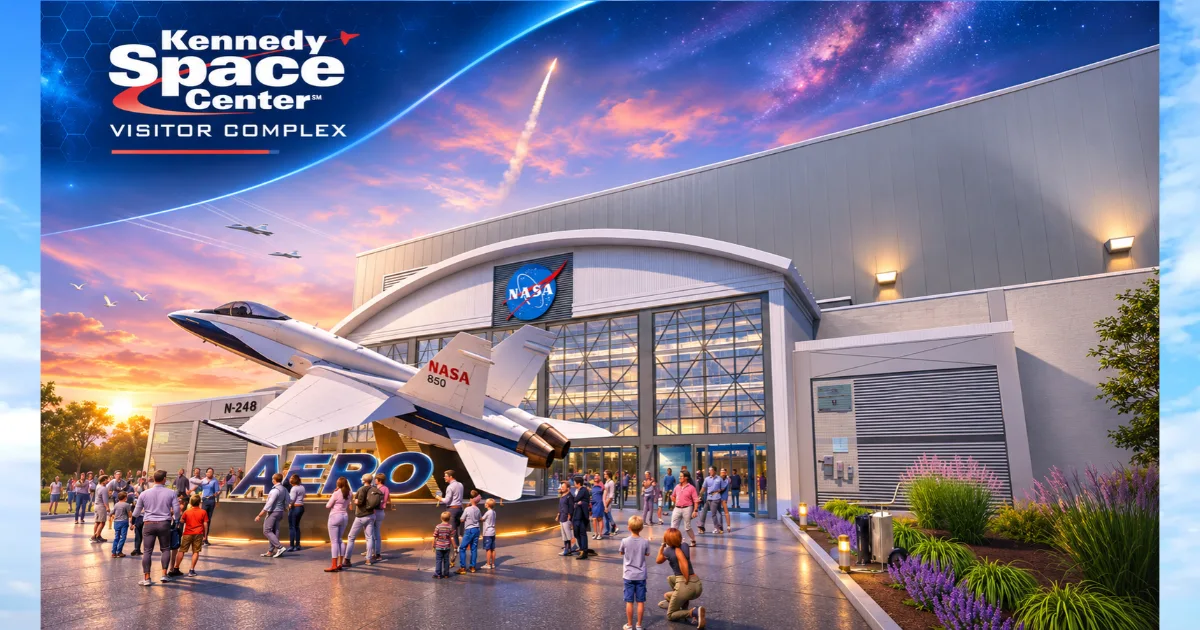
Announced during IAAPA Expo 2026, the innovative attraction combines roller coaster technology, interactive flight simulations, and more than six decades of NASA history.
Source: Kennedy Space Center Visitor Complex and Maurer Rides
Written by Chris & Will Press
November 18, 2026
For more than six decades, NASA's Kennedy Space Center has represented exploration, innovation, and humanity's determination to reach beyond the boundaries of Earth. From the historic Apollo missions that carried astronauts to the Moon to the Space Shuttle Program and today's ongoing space exploration efforts, the Florida spaceport has played an essential role in some of the world's most extraordinary scientific achievements.
Now, Kennedy Space Center Visitor Complex is preparing to introduce a new experience that will allow visitors to explore another important part of NASA's mission: the science of flight.
During IAAPA Expo 2026 in Orlando, Kennedy Space Center Visitor Complex and German ride manufacturer Maurer Rides announced Aero Test Lab, an immersive attraction featuring SPIKE® Coaster technology. The announcement, made November 17, included the unveiling of one of the ride vehicles, offering attractions industry professionals an early look at the engineering behind the experience.
Currently under construction at the visitor complex, Aero Test Lab is designed to combine the excitement of a roller coaster with interactive technology and simulated aeronautical testing.
Rather than simply taking passengers on a traditional thrill ride, the attraction will place guests inside a simulated NASA flight-testing facility, where they will experience the challenges and decision-making processes associated with experimental aviation research.
Before boarding, visitors will observe the ride vehicles launching from the station, approaching a viewing gallery, and banking overhead. The experience then begins with a simulated preflight inspection and a briefing introducing the test objectives, onboard controls, and flight displays.
Once aboard, participants will travel through a series of testing zones incorporating digital displays, visual effects, audio cues, and simulated performance feedback. Riders will have opportunities to influence their vehicle's speed, accelerate through designated boost zones, and contribute to their flight-test scores using interactive controls.
The attraction's simulated scenarios will explore subsonic, supersonic, and hypersonic flight conditions, as well as structural performance, lightning strikes, icing detection, fluid mechanics, and inversion testing. These experiences are intended to introduce the scientific considerations engineers must evaluate when developing and testing aircraft.
Therrin Protze, chief operating officer of Kennedy Space Center Visitor Complex, explained in the announcement that the attraction is intended to connect the excitement of a thrill ride with NASA's contributions to aviation, helping visitors understand how aeronautics research influences everyday flight.
For Maurer Rides, the project represents an opportunity to demonstrate the capabilities of its SPIKE Coaster system, combining dynamic track elements, acceleration, and rider interaction with a detailed aeronautics theme.
The attraction also highlights an important distinction that can sometimes be overlooked when discussing NASA.
Although the agency is widely recognized for its space missions, the first letter in NASA stands for Aeronautics. Research involving aircraft, flight safety, advanced technology, and the challenges of flying through Earth's atmosphere remains an important part of the agency's scientific work.
Aero Test Lab will bring that aspect of NASA's mission into focus, allowing visitors to explore flight principles through a combination of physical movement and simulated testing.
The new development also represents another chapter in the remarkable history of Kennedy Space Center itself.
The facility's origins date to the early 1960s, when the United States was expanding its space program under President John F. Kennedy's ambitious goal of landing astronauts on the Moon. On March 7, 1962, NASA established the Launch Operations Center on Merritt Island, Florida, as an independent field center.
Following President Kennedy's assassination in November 1963, the facility was renamed the John F. Kennedy Space Center in recognition of his vision for American space exploration.
The center would become one of the most important launch facilities in history. On July 16, 1969, Apollo 11 launched from Kennedy Space Center, carrying Neil Armstrong, Buzz Aldrin, and Michael Collins on the mission that would achieve humanity's first crewed lunar landing.
During the decades that followed, Kennedy Space Center supported additional Apollo missions, numerous scientific spacecraft launches, and the Space Shuttle Program, which began with the launch of Columbia in April 1981.
As the space program developed, public interest in witnessing these achievements grew considerably.
Early visitor opportunities began with drive-through tours during the 1960s. Guided bus tours eventually followed, and on August 1, 1967, NASA opened its permanent Visitor Information Center, providing the public with an organized destination to explore the people, technology, and achievements behind America's space program.
What began as a relatively modest educational facility gradually developed into one of Florida's most recognized attractions.
Over time, the Kennedy Space Center Visitor Complex expanded to include the Rocket Garden, the Apollo/Saturn V Center, astronaut encounters, educational exhibits, and increasingly sophisticated interactive attractions.
The Apollo/Saturn V Center, which opened in January 1997, brought a preserved Saturn V Moon rocket indoors, allowing guests to appreciate the extraordinary scale and engineering behind the Apollo Program.
In 2007, the visitor complex introduced Shuttle Launch Experience, a simulated journey designed to recreate the sensations of a space shuttle launch. Another major milestone followed in 2013 with the opening of Space Shuttle Atlantis, which showcases the historic orbiter and celebrates the achievements of the shuttle era.
These developments helped transform the visitor complex from a destination focused primarily on historical exhibits into an attraction that combines authentic space artifacts with immersive educational entertainment.
Aero Test Lab continues that evolution.
While the visitor complex celebrates the spacecraft and astronauts who helped shape history, the new attraction will introduce guests to the scientific principles that make flight possible. Its interactive format aims to encourage visitors to participate in the experience rather than simply observe it.
For the broader attractions industry, the project demonstrates how entertainment technology can be used to communicate complex scientific concepts through engaging, physically immersive experiences.
The ride's combination of acceleration, simulated testing, and rider-controlled elements could provide a different perspective on what an educational attraction can offer.
At the conclusion of Aero Test Lab, participants will be welcomed into the honorary ranks of NASA engineers, reinforcing the attraction's theme of learning through experimentation.
As Kennedy Space Center continues preserving the achievements of the past while looking toward future discoveries, Aero Test Lab represents another opportunity to inspire curiosity about science, technology, and exploration.
An official opening date for Aero Test Lab has not yet been announced. Additional details will be released as development continues.
Located approximately 45 minutes from Orlando on Florida's Space Coast, Kennedy Space Center Visitor Complex welcomes visitors to explore NASA's history and discover the innovations shaping its future.
For more information about the attraction and upcoming announcements, visit KennedySpaceCenter.com.
Sources: Kennedy Space Center Visitor Complex and Maurer Rides, November 17, 2026, press announcement; NASA Kennedy Space Center historical archives; Kennedy Space Center Visitor Complex historical records.
Source: ChrisWill Media
About the Authors: Christopher L. Antie and William Antie are podcast journalists and media personalities covering entertainment, travel, culture, events, and stories from across a wide range of industries. Together, they bring a conversational and experience-driven approach to the stories they share. Follow more from Chris & Will through their podcast, What About Our Life?, on iHeartRadio and at chrisandwill.com.