Courtesy of: Square Enix, Inc.
Written by: William Antie
There are some video games that take you back to where your journey began. Then there are others that introduce you to a part of that journey you never experienced.
For me, Final Fantasy Resonance does a little of both.
My introduction to the Final Fantasy franchise began during the original PlayStation era, when Final Fantasy VII arrived in 1997. I didn't experience the original games on the Nintendo Entertainment System (NES) or Super Nintendo Entertainment System (SNES). Those earlier adventures, with their 8-bit and 16-bit graphics, belonged to a generation of gaming that came before my own experiences with the series.
By the time I stepped into the world of Final Fantasy, the franchise was already evolving into something entirely different. Characters were being brought to life with 3D graphics, cinematic storytelling was becoming increasingly ambitious, and the music helped create adventures that would stay with players for years.
Now, nearly three decades after Final Fantasy VII first arrived on PlayStation, Square Enix is revisiting the visual traditions that helped establish the franchise.
Releasing today, October 22, 2026, Final Fantasy Resonance is the first game in the series to embrace an HD-2D presentation, combining classic pixel art with modern environments, lighting, and cinematic effects.
What makes this adventure particularly interesting is how it brings together characters and influences from different generations of Final Fantasy, including some from the games I remember.
A STORY FROM ANOTHER GENERATION
Interestingly, Final Fantasy Resonance isn't an entirely original adventure. Its story is based on the first season of Final Fantasy Brave Exvius, a mobile RPG that first launched in Japan in 2015.
That's another entry in the franchise I never played.
For perspective, Final Fantasy VII arrived in 1997, meaning Brave Exvius came along nearly two decades after my introduction to the series. While Resonance draws its story from that mobile adventure, Square Enix has extensively rebuilt and reimagined the experience for modern gaming platforms rather than simply bringing over the original version.
At the center of the story is Rain, a young knight of the Kingdom of Grandshelt and commander of its airship squadron. Bright, determined, and guided by a strong sense of what he believes is right, Rain is joined by his childhood friend Lasswell, who serves as his deputy commander.
The two share a close bond, although their personalities couldn't be more different. Where Rain tends to follow his convictions and act on impulse, Lasswell approaches situations with a more disciplined and thoughtful perspective.
Their adventure begins when they're tasked with investigating a disturbance surrounding the Earth Crystal, one of the powerful crystals responsible for protecting their world.
What follows is a journey involving a mysterious armored figure known as Veritas of the Dark, threats to the remaining crystals, and the appearance of Fina, a mysterious young woman whose connection to the unfolding events raises questions of its own.
It's a familiar foundation for Final Fantasy: crystals, kingdoms, friendship, conflict, and a world whose future rests on the decisions of a handful of heroes.
And sometimes, that's all a great adventure needs to begin.
A CLASSIC WORLD WITH A MODERN COAT OF PAINT
One of the biggest selling points of Final Fantasy Resonance is its HD-2D presentation. Square Enix describes the project as an opportunity to explore what might have happened if Final Fantasy had continued pushing the limits of pixel art.
It's an interesting idea, although I can't say the results always worked for me.
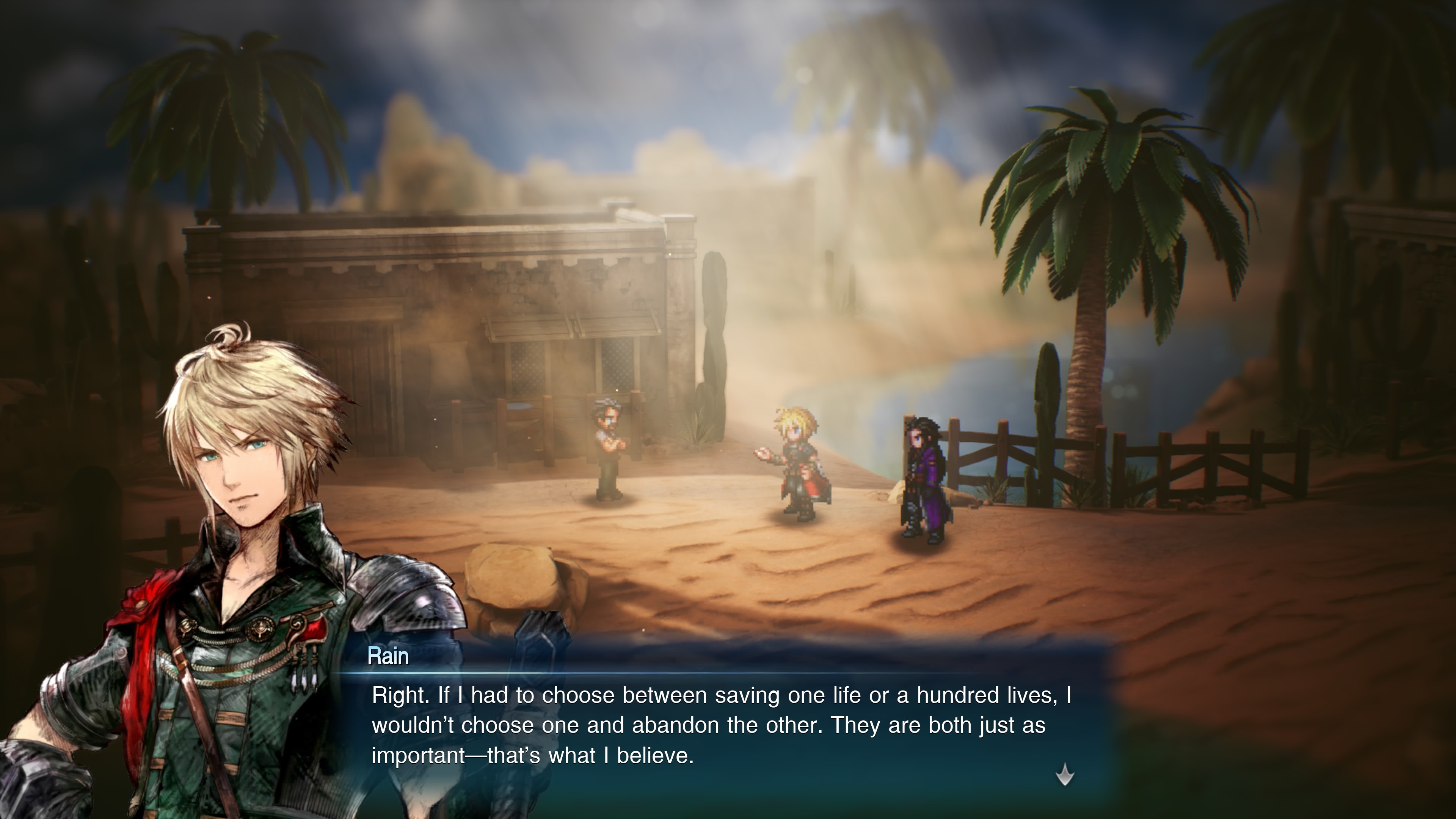
Some of the enlarged pixel art looked rough, almost as though the visual quality had been reduced rather than enhanced. While I understand the intention of bringing traditional sprites into modern environments, certain moments felt less polished than I expected.
That's particularly disappointing because some of the environments are genuinely beautiful.
During battles, I enjoyed watching the subtle movements happening in the background. Clouds drift across the distant sky, leaves respond to the breeze, and the wind gives the scenery a sense of life beyond the characters fighting in the foreground.
The lighting also creates wonderful atmospheric moments. In certain interiors, dust particles catch the light and begin to resemble tiny sparkles floating through the air. It's a small detail, but one that makes the world feel more believable.

Unfortunately, these strengths make some of the visual inconsistencies even more noticeable.
Certain opening cinematics were especially distracting. Instead of being completely focused on what was happening, I found myself looking at the oversized pixels and how some environmental effects were presented. Flames, for example, appeared heavily pixelated even when the surrounding scenery featured more detailed HD-2D artwork.
I understand why the characters themselves are represented as pixel-art sprites, but I would have preferred to see effects like fire receive the same visual treatment as the environments.
The character sprites also have an unusual appearance. To me, they look like a hybrid between traditional 16-bit characters and something inspired by the PlayStation generation. During battles, the playable characters can appear relatively small compared with the enemies they're facing. I'm not sure whether that difference was intentional, but it's something I noticed.
There are also differences between the in-game sprites and their illustrated portraits. Rain, for example, appears to wear a more blue-colored top in his sprite, while his portrait features a darker, almost teal-colored outfit. I would have appreciated greater consistency between the two.
The Visions, which bring familiar heroes from other Final Fantasy titles into this adventure, also require some adjustment depending on how you remember those characters looking in their original games.
Another artistic decision I wasn't entirely sold on was the use of mostly static, hand-painted portraits during conversations.
Although the illustrations are attractive, I would have preferred character portraits reminiscent of mid-1990s RPGs, perhaps focusing more closely on the characters' faces. Better yet, imagine two illustrated portraits facing one another during a conversation, with their eyes blinking and mouths moving as the dialogue is spoken.
Even subtle animation could have made these exchanges feel more natural while preserving the classic presentation. Instead, the portraits generally change expressions between dialogue boxes while the voice acting plays over them.
Ultimately, Final Fantasy Resonance feels like a classic RPG trying to find its place in the modern era. There's plenty to admire in the environments, lighting, and atmosphere, but the combination of pixel art, HD-2D scenery, and illustrated portraits doesn't always feel as cohesive as I would have liked.
Visually, I think it could have accomplished more. What it provides is certainly enjoyable in places, but some of its artistic choices left me wanting greater consistency.
VOICES THAT BRING THE CHARACTERS TO LIFE
Fortunately, where the illustrated portraits sometimes lack expression, the voice acting helps give the characters personality.
Rain is voiced by Clifford Chapin, Lasswell by Alejandro Saab, and Fina by Lizzie Freeman. The mysterious Veritas of the Dark is voiced by Ian Sinclair.
For the most part, I felt the performances complemented their characters, although a few took some getting used to.
Rain initially sounded a little too youthful to me, almost as though his voice hadn't completely matured. However, as I continued experiencing the story, I noticed his delivery becoming deeper and more vivid. Whether intentional or simply how I perceived the performance, it began to suit his developing characterization.
Lasswell, on the other hand, was fantastic from the beginning. I absolutely loved Alejandro Saab's tone. There's a seriousness and confidence to his performance that complements Lasswell's disciplined personality.
Fina was a different experience. Her voice initially felt a little too light for my taste, sometimes even becoming somewhat annoying. However, as more of her personality emerged, I began to appreciate why that vocal approach might have been chosen for her character.

Something else I particularly enjoyed was how the voice acting extends into the battles themselves.
The original pixel-based Final Fantasy titles didn't have spoken dialogue accompanying their combat encounters, so hearing characters speak during their turns adds another dimension to the experience.
And then there are the little victory celebrations.
One of my favorite moments happens after winning a battle, when Rain and Fina sing "Vic-tor-y" along with the familiar Final Fantasy victory melody.
Lasswell begins to join in before stopping himself with, "Vic... oh I'm not doing this."
I loved that!
It's such a small exchange, but it captures the personalities of all three characters without needing a lengthy conversation. These humorous touches make the party feel more connected and give players something to smile about after a fight.
I was also particularly impressed with the voice acting during the Sanctums of Light encounters, where the stories of legendary Final Fantasy characters are revisited. Hearing these moments performed gives their experiences an additional sense of emotion and significance.
While I still believe the visual presentation of the conversations could have been stronger, the voice performances themselves add plenty of charm.
THE MUSIC: FAMILIAR MELODIES AND NEW ARRANGEMENTS
Music has always played an important role in my relationship with Final Fantasy.
Some of the games I've experienced had a way of pulling me into their worlds almost immediately. Whether it was a memorable opening sequence or a musical arrangement that seemed to announce the beginning of an unforgettable adventure, the soundtrack often became just as important as the gameplay.
I didn't quite get that same feeling from the beginning of Final Fantasy Resonance.
That's not to say the soundtrack doesn't have its moments.
The music, composed and arranged by Elements Garden under the leadership of Noriyasu Agematsu, includes 33 newly recorded tracks alongside music from Final Fantasy Brave Exvius.
I particularly enjoyed the battle theme, which features some wonderful orchestration. The percussion section stood out to me, especially as the music builds toward the end of a passage. There's a sense of momentum in the arrangement that keeps you engaged and makes you want to continue playing.
Some of the quieter background music also caught my attention. In fact, one particular theme was so enjoyable that I paused the game and simply sat there listening for a while.
I love when a soundtrack can do that.
Another highlight was the revised Chocobo theme. Hearing that familiar melody performed with violins and other orchestral instruments was a welcome interpretation of one of the franchise's most recognizable musical pieces.
Overall, the soundtrack is something I enjoyed and would gladly listen to outside of the game. However, I can't say it stands out quite as much as the music from some of the Final Fantasy adventures I remember.
There are beautiful arrangements here, but I was hoping for a little more of that unforgettable musical identity that has stayed with me throughout the years.
TURN-BASED COMBAT WITH A STRATEGIC TWIST
While the presentation embraces the franchise's past, the gameplay introduces several mechanics that help modernize traditional turn-based combat.
One of the first things players will notice is the timeline displayed across the top of the battle screen. This shows the upcoming order in which party members and enemies will act, including actions extending into the next turn.
Having that information available adds a layer of strategy. Rather than simply selecting attacks and hoping for the best, players can prioritize enemies, prepare for incoming attacks, and make better decisions about when to use particular abilities.
One mechanic I particularly welcomed was the Stagger system.
Enemies have a Stagger Gauge beneath their health bar that decreases through attacks, particularly those exploiting elemental weaknesses. Once staggered, enemies temporarily lose the ability to act and have their defenses lowered, while the responsible party member earns an additional action during a bonus phase.
If every enemy on the battlefield becomes staggered, a Sweeping Stagger occurs, granting the entire party additional actions.
I enjoyed waiting for these opportunities during combat because they gave battles another objective beyond simply reducing an enemy's health to zero.

Players can also unleash Limit Bursts, powerful abilities activated after filling a character's Limit Gauge. These gauges increase when characters stagger enemies or receive damage.
Some Limit Bursts deliver devastating attacks, while others provide beneficial effects that can help the party survive difficult encounters.
Together, these mechanics encourage players to think about the order of their actions, manage resources, and take advantage of opportunities as they become available.
VISIONS: WHERE GENERATIONS OF FINAL FANTASY MEET
Perhaps my favorite addition to Final Fantasy Resonance is the Vision system.
Visions are crystallized essences of characters who can lend their powers to Rain and his companions. Some are connected to the world of Brave Exvius, while others come from different generations of the Final Fantasy franchise.
The roster includes familiar characters such as the Warrior of Light, Terra, Cloud, Shantotto, and Y'shtola, bringing together heroes whose adventures helped shape the series.
For me, this is where Resonance becomes particularly meaningful.
I didn't experience the original 8-bit and 16-bit adventures, but I certainly recognize characters from the PlayStation generation. Seeing familiar faces represented in a game that embraces an earlier artistic tradition creates an interesting connection between different periods of Final Fantasy history.
However, what I enjoyed most wasn't simply seeing these characters again.
It was how their stories were presented.

Scattered throughout the world are special locations known as Sanctums of Light. These encounters revisit stories associated with legendary heroes, allowing players to experience situations from their perspectives.
Rather than simply collecting a character, you're presented with circumstances involving that hero and asked to respond to questions about the decisions being made.
Each question offers three possible responses, and the goal is to resonate with the character's experiences and perspective to earn their assistance.
I absolutely loved this approach.
It gives the Visions more purpose than simply being familiar characters appearing for nostalgic reasons. Their stories become part of the experience, offering players a chance to reflect on the decisions and circumstances that helped define them.
It's also a wonderful way to introduce players to heroes whose original adventures they may never have experienced.
Once obtained, Visions can be equipped to playable characters, providing stat enhancements, magic, and additional combat abilities.
Each party member can equip one active Vision at a time, and continued use increases their affinity, allowing additional skills and abilities to be unlocked.
One detail worth mentioning is that this progression is specific to each playable character.
For example, if Rain strengthens his affinity with a particular Vision, that development doesn't automatically carry over to Lasswell or another party member. Each character must build their own affinity with that Vision.
Fortunately, abilities learned from Visions can remain available even after equipping a different Vision, provided they fit within the character's ability cost limit.
That creates opportunities to combine skills from multiple Visions and develop specialized character builds rather than relying exclusively on a single set of abilities.
It's a system that rewards experimentation while giving players more control over how their party develops.
AWAKENING VISIONS AND UNLEASHING RESONANCES
The Vision system also incorporates Awakening, allowing players to strengthen their Visions through a resource known as magicite.
Awakening unlocks stronger abilities, higher-level skills, and more powerful magic. Each Vision has three awakening stages, with more advanced stages requiring higher-grade magicite.
Because magicite is limited, deciding which Visions to awaken becomes an important part of character development.
Another powerful mechanic is Resonance, which becomes available after triggering a Sweeping Stagger.
At the end of the bonus phase, players can activate a special technique associated with an equipped Vision. These abilities can deliver substantial damage, affect multiple enemies, or provide beneficial effects to the party.
Only one Resonance can be activated per Sweeping Stagger, so choosing the most appropriate technique becomes another strategic decision.
The attacks also feature unique cinematic sequences, bringing the characters and their powers to life in a more dramatic fashion.
It's another example of how Resonance uses its legacy characters as more than recognizable appearances. Their abilities become meaningful parts of the combat system.
EXPLORING A WORLD BOTH OLD AND NEW
Beyond the battles and Visions, Final Fantasy Resonance brings back several recognizable elements of the franchise.
Espers, powerful summoned beings, can join the party during combat for three turns before unleashing a finishing attack. Familiar summons such as Siren and Ramuh are among those featured, although their abilities require a considerable amount of MP to use.

Airships also return, eventually allowing players to explore additional portions of the world and reach areas that were previously inaccessible.
Square Enix has outlined several optional challenges beyond the main story, including a Colosseum, the Chamber of Arms, powerful optional bosses, and a confrontation with Ultima Weapon. These activities offer further opportunities for players interested in exploring more of what the game has to offer.
Of course, not every familiar feature works quite the way I remember.
One example involves Chocobos.
Back when I played Final Fantasy VII on the original PlayStation, riding a Chocobo across the world map allowed players to travel without encountering random enemies.
That was one of the advantages of using them.
In Final Fantasy Resonance, however, riding a Chocobo doesn't provide that same protection. Instead, I found that its main benefit was simply moving across the world faster than traveling on foot or dashing.
It's a relatively small difference, but one that stood out because of how useful I remember Chocobos being in my earlier Final Fantasy experiences.
A RETURN TO THE PAST, A JOURNEY THROUGH GENERATIONS
Looking at Final Fantasy Resonance, I keep coming back to the generations of the franchise that brought us here.
My own journey began with Final Fantasy VII on PlayStation. I didn't experience the original NES or SNES adventures, and I never played the mobile game Final Fantasy Brave Exvius, whose story forms the foundation of this new release.
Yet Resonance brings elements of all those periods together.
There's something appealing about discovering Rain and Lasswell's adventure through an artistic style inspired by the earliest days of the franchise, while also reconnecting with heroes from the games I remember.
That doesn't mean every aspect of the experience completely won me over.
I would have liked a more consistent visual presentation, particularly with the character sprites, environmental effects, and illustrated portraits. The soundtrack has some lovely arrangements, although it didn't always leave the same impression as the music from other Final Fantasy titles I've enjoyed.
But there are also things I genuinely appreciate.
The environmental details can be beautiful. The voice acting brings personality and humor to the characters. The Stagger system adds a welcome strategic element to battles, and the Sanctums of Light provide one of my favorite ways of revisiting the franchise's history.
Perhaps that's what makes this particular entry interesting.
Final Fantasy Resonance doesn't simply ask players to look backward. It brings together stories, characters, and ideas from different generations, creating opportunities to appreciate the franchise from another perspective.
For those who grew up with the original pixel-art games, it may feel like a return to familiar territory.
For someone like me, whose journey began during the PlayStation era, it's a chance to experience something a little different.
A story I hadn't played.
A visual tradition that came before my time with the series.
And familiar heroes whose adventures still resonate with me today.
Sometimes, returning to the past isn't about remembering where you've been.
It's about discovering what came before—and appreciating how far the journey has taken you.
________________________________________
FINAL FANTASY RESONANCE — AVAILABLE NOW
Final Fantasy Resonance is available as of October 22, 2026, on PlayStation 5, Nintendo Switch 2, Nintendo Switch, Xbox Series X|S, and PC via Steam and Xbox on PC.
For more information, visit the official Final Fantasy Resonance website.
Source: ChrisWill Media
About the Authors: Christopher L. Antie and William Antie are podcast journalists and media personalities covering entertainment, travel, culture, events, and stories from across a wide range of industries. Together, they bring a conversational and experience-driven approach to the stories they share. Follow more from Chris & Will through their podcast, What About Our Life?, on iHeartRadio and at chrisandwill.com.