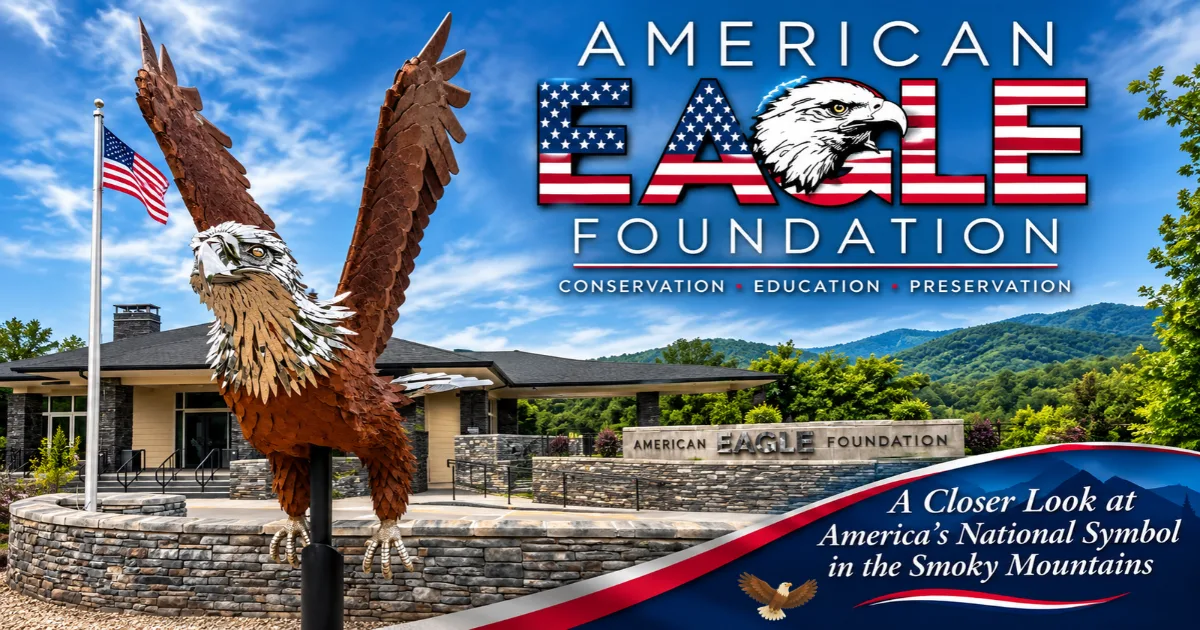
Chris & Will discover that seeing a bald eagle up close is impressive—but understanding the stories behind these birds makes the experience far more meaningful.
Experience courtesy of Visit Sevierville
Written by Christopher L. Antie
Located in Kodak, Tennessee, just outside the Sevierville area and surrounded by an impressive Smoky Mountain backdrop, the foundation’s conservation campus gives visitors an opportunity to see bald eagles and other birds of prey while learning why some of these animals can no longer survive independently in the wild.
Will and I travel to destinations looking for the experiences our audience might want to add to their own journeys. At the American Eagle Foundation, we arrived knowing relatively little about the organization beyond its work with eagles. We left with a much greater understanding of the birds themselves, the challenges involved in rehabilitation, and the responsibility required to protect them.
The American Eagle Foundation’s headquarters sits on a 57-acre property in the foothills of the Great Smoky Mountains and is home to more than 40 resident raptors, including eagles, hawks, owls, falcons, and vultures. The campus also includes a Raptor Museum and expansive outdoor aviaries.
Before this visit, our understanding of eagle conservation was fairly limited. That changed quickly. The educational experience explains not simply what kind of birds visitors are seeing, but why some of them remain in human care. Staff members discussed the histories of individual birds, the circumstances surrounding rescues, and why certain injuries or behaviors can make returning an eagle to the wild impossible.
Learning why a bird cannot be released creates a different perspective than simply standing in front of an enclosure. The eagle stops being only a national symbol and becomes an individual animal with its own history and needs.
One of the foundation’s best-known ambassadors is Challenger, a bald eagle who became human-imprinted after being raised by people and consequently could not successfully survive on his own in the wild. Challenger went on to become the first bald eagle trained to free-fly during the National Anthem at major sporting events and helped introduce countless people to bald eagle conservation.
The foundation’s relationship with Dollywood also dates to 1991, when Eagle Mountain Sanctuary and the Wings of America program began introducing theme-park visitors to non-releasable birds of prey. In 2026, the foundation and Dollywood announced that the sanctuary’s non-releasable bald eagles would make the Kodak conservation campus their permanent home, bringing even more of the organization’s work together in one location.
Our strongest moment came when we had the opportunity to participate in a feeding experience. Standing only a fence away from an eagle and watching its energy, movement, and reaction to being fed fish created a far more personal encounter than simply observing the bird from a distance. It was entertaining, educational, and emotional at the same time.
The foundation currently offers its Talons & Tidbits experience, which allows guests to feed birds of prey with tongs while handlers explain their behaviors and care. For us, the staff interaction made that experience work.
Our handler answered questions thoroughly and paired factual information with the individual stories of the birds. The conversation never felt like a memorized presentation. It became an opportunity to understand what these animals had experienced, and the work required to care for them.
The biggest weakness in the visitor experience is not what happens once guests reach the birds. It is getting there. The American Eagle Foundation openly notes that its outdoor aviaries require a 1.5-mile round-trip walk from the museum along a paved, ADA-compliant path.
For us, that distance felt substantial. The property itself is beautiful, with open land and the Smoky Mountains providing a striking backdrop, but much of the walk felt disconnected from the attraction. There was little along the route to continue the educational experience or make the distance feel purposeful. This is an area where relatively simple additions could significantly improve the visit.
More benches, shaded resting points, educational signs, conservation facts, interactive elements, or even transportation assistance could make the route more comfortable while turning the walk itself into part of the story. That becomes especially important for older visitors, families with small children, or anyone with mobility concerns. Although the path is paved, guests should understand the distance before beginning the journey.
We had a similar reaction to portions of the aviary environment. The enclosures appeared clean and spacious, but from a visitor's perspective, some areas seemed as though they could make greater use of the substantial property and incorporate richer habitat features.
That observation is not a judgment about the medical or professional care of the animals. The foundation states that its non-releasable bald eagles receive daily care, fresh food and water, visual health checks, and annual physical examinations.
Rather, it is an opportunity for the visitor environment to continue evolving alongside an organization that is already expanding its Kodak campus. The foundation itself describes the property as developing in phases, including future conservation, rehabilitation, and research components.
Despite those areas for improvement, this is not an experience we would suggest simply adding if you happen to have spare time.
It is worth planning for.
Families can turn the visit into an educational experience. Children can discover that eagles are more than something seen on a flag or coin. Animal lovers and bird enthusiasts can get considerably closer to raptors than they might expect. Educators can find meaningful conservation material, while photographers and travelers looking for something beyond the traditional Smoky Mountain attraction circuit will find something distinctly different.
The American Eagle Foundation succeeds most when visitors interact directly with the people and birds behind its mission. Feeding an eagle may be the moment that gets someone's attention.
Chris & Will give the American Eagle Foundation 8 out of 10 smiles for its beautiful setting, meaningful conservation education, knowledgeable staff, and memorable personal interaction with the birds. Points are lost for a lengthy walk to the aviaries that could be better incorporated into the experience and for portions of the guest environment that still have room to develop.
For videos and interviews, please visit our YouTube page @officialchrisandwill or under press on the official website @chrisandwill.com. You can also listen to our podcast show called What About Our Life? on iHeartRadio.
Source: ChrisWill Media
About the Authors: Christopher L. Antie and William Antie are podcast journalists and media personalities covering entertainment, travel, culture, events, and stories from across a wide range of industries. Together, they bring a conversational and experience-driven approach to the stories they share. Follow more from Chris & Will through their podcast, What About Our Life?, on iHeartRadio and at chrisandwill.com.